Guide to CT Scanner Types, Manufacturers, and Models
Main Factors When Choosing a CT Scan Machine Manufacturer (CT Scan Machine Brands)
The top CT scan manufacturers are Toshiba (now Canon Medical), Siemens, GE, and Philips.
All these brands have been supplying high-quality CT scanners for years and the value of their used systems is high. Furthermore, it is easy to get your hands on parts from these CT scan machine brands.
Each of the brands has CT scan models installed worldwide, but some regions have a stronger presence of one OEM.
Therefore, the main factor in choosing between theese CT scan machine manufacturers is simply what service providers you have good access to.
On top of this, you might have a strong personal preference. So remember to let the seller know if this is the case, or if you are used to working with a specific CT scan machine manufacturer.
Each CT scan manufacturer supplies a little different types of CT scanners.
- Philips: Ingenuity and Brilliance
- Toshiba: Aquilion and Activion
- Siemens: Somatom Emotion, Sensation, and Definition
- GE: BrightSpeed, Discovery, LightSpeed, and Optima
CT Scanner Slices – What Slice Count Do I Need
This is a specification that comes up early in discussions of CT scanner purchases.
In the second-hand market, the commonly available CT slice counts include 16, 32, 40, 64, and 128 slices.
And more and more we also see 256 and 320-slice CT scanners. So it is obvious that there are many different CT scan slice types to choose from.
Systems with 4 and 8 slices are still found in the market but are in the process of being withdrawn.
The main effect of the slice count is on the time it takes to perform a CT scan.
The pros of a CT scanner with a higher number of slices are:
- Reduced scan times
- Higher patient throughput
- Lower radiation doses
- More detailed images with fewer artefacts
- Options for advanced imaging, such as cardiac exams
Nevertheless, a higher number of slices also means a higher price. And if you only perform routine studies, the extra cost is likely not worth it – For many clinical facilities, a lower slice count with lower cost will be the soundest investment.
Therefore, when deciding on a CT slice count make sure to balance your clinical needs, your patient flow targets, and your budget.
So, which of the different types of CT scanners matches your needs?
Lets us look in detail at the individual slice counts, from 4 to 320 slices.
4- and 8-slice CT Scanners
4- or 8-slice CT scanners are a good fit for veterinarian clinics or departments with limited patient throughput and no need for fast diagnosis.
These scanners are among the cheapest on the market, but also perform scans slower.
Furthermore, they are less powerful.
16-slice CT Scanners
The 16- slice is the first choice of many clinics and radiology departments with fairly steady patient flows, as they are faster than the 4- or 8-slice scanners.
The 16 slice units are workhorses great for standard general studies.
This also makes them suitable for urgent care centers and ERs.
32-and 40-slice CT Scanners
CT scanners with 32 and 40 slices are typically found in similar situations and facilities as the 16 slice.
The difference is that the extra slices provides more coverage per gantry rotation, and thus further reduce the scan time compared to the 16-slice.
Therefore, the obtained image is not influenced by motion artifacts to the same extent.
Naturally, the price of 32 or 40 slice units are naturally a bit higher than the price for the lower slice units.
64-slice CT Scanners
The 64-slice CT is standard for hospitals and imaging centers.
Thanks to the reduced scan times, more advanced studies, such as cardiac, can be performed.
Its speed and accuracy makes it suitable for practices with moderate to high patient throughput.
In terms of cardiology, a 64-slice CT scanner can perform cardiac examinations but still require slowing of the heart rate.
+128-slice CT Scanners
In this category, there are different types of CT scanners. These are the top-notch CT scanners, ranging from 128 to 320 slices. These systems can provide whole-body scans in seconds while providing incredibly sharp 3D images of any organ.
The capabilities of these scanners are often excessive in a standard clinical setting.
Therefore, they are usually found supporting specialty practices, such as cardiac departments, research facilities, or where the volume of patients is very high.
If you are not sure what cardiac CT to get, you can read our guide to cardiac CT scanners – it will help you decide which system will be the best fit for you.
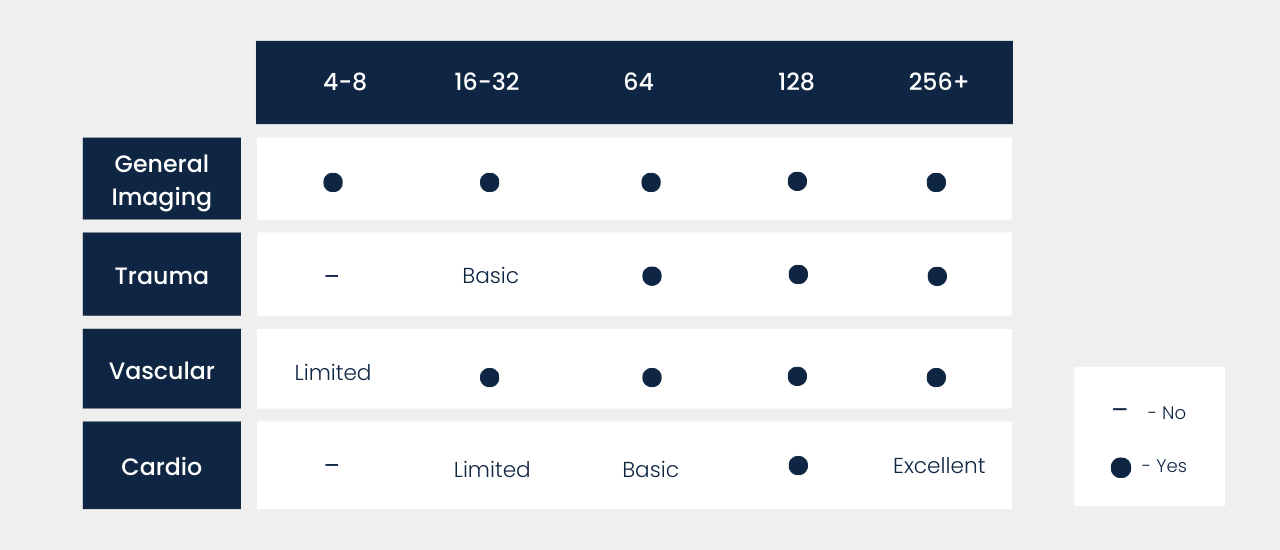
To sum up, how many slices do you need based on the exams you perform?
As CT scanners are used for many different examinations, knowing the examinations your system will be used for will help you determine what CT scanner type is the best for you.
All the different types of CT scanners can perform general imaging procedures, for example abdominal, which includes the scanning of internal organs such as the liver and kidneys.
However, certain procedures, such as cardiac, rely on higher slice counts to deliver sufficient image quality.
To get a better overview of CT scanner applications in relation to slices, see the table below where we have listed all CT scan slice types: