
Differences between Closed and Open MRI Machines
Differences between Closed and Open MRI Machines
You may have heard about open and closed bore MRI systems before.
So, how do they differ overall?
Let us go over these two types of MRI machines.
Open MRI Machines
As the name suggests, this type of MRI machines is open. Most open MRIs do not use superconducting magnets, they use permanent magnets (resistive magnets). Thus, instead of liquid helium, they use water and air cooling, which is less expensive in terms of labour and money.
However, there are some exceptions: A 0.6T, 1.0T, and 1.2T, for example, are completely open bore MRI scanners with superconductive magnets, which utilize the use of liquid helium.
Open bore MRIs use two parallel magnets with an opening in between to produce images. Since MRI technologies are constantly evolving, there are nowadays technologies in the market where the magnets are set upright, producing an axial image.
Open MRIs are primarily designed to suit larger patients and patients struggling with claustrophobia. And because most open MRIs are low field, using less than 0.5T, it can be a challenge to tell fat and water apart during the scan, which can result in lower resolution images.
Nevertheless, since the technology is progressing, the clarity of the low-field MRIs has increased over time. Hence, an open MRI can balance your imaging needs, capital costs, and patient comfort.
Closed MRI Machines
This type of MRI is the most demanded in the market, due to speed, image quality, variety of options and sequences. A closed MRI has the shape of a “donut”. Unlike open MRIs, closed MRIs do not come with a permanent magnet option, they are always superconductive, which generates an astounding amount of heat, therefore, liquid helium is required to maintain the superconductivity of any high-field magnet.
Generally, closed magnets start at 1.5T. However, since they are closed, many patients struggle with the feeling of claustrophobia. The systems may be uncomfortable for obese patients. Therefore; wide bore, also called large-bore MRIs were developed. All top manufacturers nowadays offer a 70cm “wide bore” option.
Just to give you a few examples:
- Siemens Espree, Aera, Altea, Sola 1.5T / Verio and Skyra 3.0
- Philips Ingenia and Ingenia Ambition 1.5T/ Ingenia 3.0T, and Ingenia Elition 3.0T
- GE 450W, Voyager, and Creator 1.5T/ MR750W, Signa Pioneer 3.0T
- And Canon Medical offers a 71cm bore in their Vantage Titan, Orian 1.5T, and Vantage Galan 3.T
Overall, closed MRI scanners scan faster and are suitable for a higher number of applications, as you can see in the table in the next chapter.
But enough about open and closed MRIs. Let us investigate MRI field strength, which is measured in Tesla.
MRI Field Strength – Measured in Teslas
For now, let us get an overview of the Magnetic Field Strength (MFS) measures in Tesla.
When medical practitioners refer to MRI scanners, they often say that the scanner is a 1.5T or 3.0T MRI.
That is because MRIs are defined by their magnetic field strength measure in Tesla (T), and the higher the Tesla, the stronger the magnet.
Fun fact: The 1.5 Tesla MRI is 15,000 gauss, the Earth’s magnetic field on the surface is anywhere between 0.25 – 0.65 Gauss, which is 23,000 to 60,000 times stronger than the gravity of the planet Earth.
Across the MRI industry, the most common scanners are 1.5T or 3.0T. Nevertheless, you can find MRI scanners with strength below 1.5T, such as the 0.2T, 0.3T, 0.4T, and also MRIs up to 7.0T. Since 7.0T MRIs are less common and usually only appear in clinical research institutions, we do not cover them in this guide.
Low-field MRI Machines: 0.2T – 0.4T
Most of these systems are open bore MRIs with a very small exception, of extremity dedicated MRI scanners. Although the MR market is dominated by superconducting magnets with a field strength of 1.5T and higher, a lower field scanner also has certain advantages. For example, lower initial purchase price, operational costs, service, and annual running costs.
Furthermore, low-field MRIs are a good alternative for claustrophobic or uneasy patients. Typically, practitioners utilize a 0.2T MRI scanner for extremities only, while 0.3T and 0.4T MRI can also be applied in full-body examinations.
High-field MRI Machines: 1.0T, 1.2T, 1.5T and 3T
These systems are very powerful. As mentioned, the higher the Tesla, the stronger the magnetic field, which leads naturally to better images. While most currently available 1.0T and 1.2T MRIs are designed as open MRIs, 1.5T and 3T are closed. Since 1.5T and 3T are currently the most common in the market, let us look at them in more detail.
1.5T MRI Scanners
Nowadays, 1.5T MRIs are the standard in MRI imaging in a clinical setting. They are faster than lower strength MRIs and are sufficient for the majority of routine scans done today. Therefore, they account for most MRIs currently in use.
Typically, you would use 1.5T MRI scanners for:
- General imaging
- Extremities
- Cardiac imaging
3T MRI Scanners
When performing examinations that need to be very detailed, you should consider a 3T MRI scanner.
3T will shine in specialties such as:
- Advanced brain imaging (DWI, DTI spectroscopy)
- ASL (brain perfusion)
- Prostate scans
- fMRI
- Blood prefusion
- Bone marrow
So, if you do not intend to focus on a specialization such as brain imaging, the 1.5T MRI will give you the image detail you need at a lower cost than the 3T MRI.
To get a better understanding of what exams can be performed by the different Teslas MRIs, check the table below.
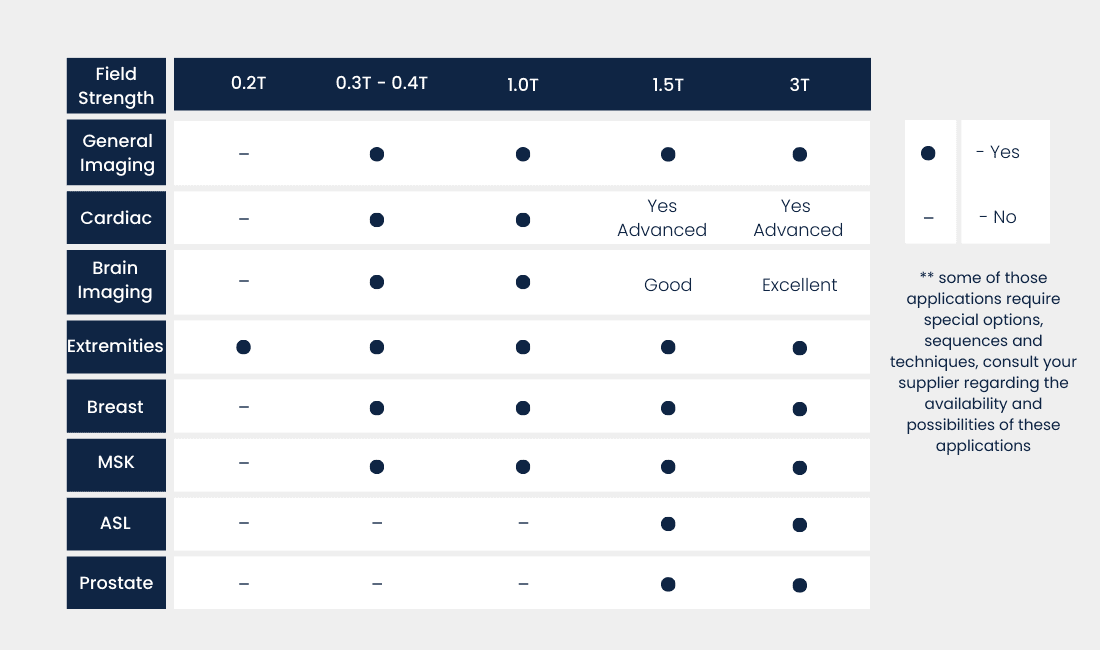
Because the 1.5T and 3T are closed MRIs, some patients may find them claustrophobic.
In addition, the purchase prices of the latest models can be high. The same applies to their maintenance costs, which are higher because these MRI scanners are helium-cooled.