
What Is a Mobile C-arm Machine?
What Is a Mobile C-arm Machine?
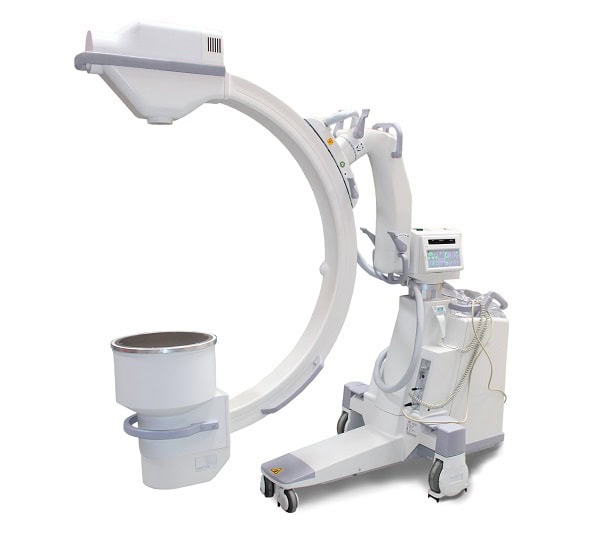
In brief, a C-arm machine is a piece of medical imaging equipment that operates on the basic principle of X-ray technology.
This fluoroscopy device is used to visualise patients’ anatomy in the operating room during surgery. This is different from most other X-ray equipment that is used for diagnostics and therefore generates revenue. For example, CT scanners, Rad rooms, R/F rooms, or Cath lab machines.
Why are they called C-arm machines?
That is due to the C-shaped arm, which is used to connect the X-ray source (the X-ray tube) and the X-ray detector (the image intensifier).
Its special semi-circular design allows the physician to move it more freely, covering the patient’s whole body and taking images wherever needed.

And what is fluoroscopy and how does it work?
The C-arm machine is a fluoroscopy system. Fluoroscopy is a method providing real-time X-ray imaging, which is particularly useful for guiding various diagnostic and interventional procedures.
Though you should remember that C-arms are generally not used in diagnostics, they are made for surgery.
Since the C-arm’s fluoroscopy technology enables the machine to provide real-time, high-resolution X-ray images, the surgeon can monitor the progress of the procedure and make decisions accordingly.
C-arm machines have several imaging modes:
- Continuous fluoroscopy – viewing live images (not acquiring images)
- Pulsed fluoroscopy – viewing intermittent live images to reduce dose during long procedures
- Exposure – higher dose, single or multiple image acquisition (in, for example, Digital Subtraction Angiography (DSA) or cardio)
The Main Question Is, What Are C-arm Machines Used for?
C-arms are mobile, therefore, the most common use is in studies that require maximum positional flexibility. They are great for:
- General surgery, orthopedic procedures, and urology procedures
- Vascular and neurology procedures
- Cardiac procedures
Each of these procedures has certain requirements for image intensifier, tube/generator capacity, image storage, acquisition rate, and options.
When you know the exact type of procedures you are going to use the C-arm machine for, it becomes easy to choose the right system.
So, what will you use your C-arm system for?
C-arms come with different types of image intensifiers. Commonly, you have to decide between 9″ or 12” (though Siemens makes a 13” as well).
And while a bigger image intensifier doesn’t mean better, it does means more expensive. C-arm machines that come with 12” image intensifiers cost more than 9” C-arms.

GE Fluorostar 7900
A compact and mobile C-arm that offers imaging excellence for confidence in surgery.
That is why it is even more important to know for sure which C-arm fits your practice.
In regard to general surgery, orthopedic procedures, and urology procedures, a 9″ image intensifier will be just right.
Systems such as the Siremobil Compact L from Siemens, BV Libra from Philips, Fluostar 7900, OEC 7700, OEC 865 Brivo Plus, and OEC 8800 from GE will be ideal.
The C-arms employed in this type of procedure don’t need any special options.
Usually, they come with the last image hold (LIH), limited image storage capacity, image printing, and an export function.
What about C-arms for vascular and neurology procedures?
If you mainly focus on these types of examinations, a 12″ image intensifier would be preferred.
Although you can find 9” C-arms with vascular capabilities, you will benefit more from the 12” C-arm system. Consider C-arms such as the BV Endura and BV Pulsera from Philips, OEC 9900 from GE as well as the Vista Endo from Ziehm.
The larger field of view makes it possible to see a larger part of the body and thus allows you to perform the procedure in one shot. This would be rather challenging to do with the 9″ image intensifiers.
Furthermore, the C-arm should come with a bigger tube and generator capacity as well as larger image storage. And to perform contrast imaging, the C-arm must have the Substruction and Road Map options.
And what type of C-arm machines to use in cardiac procedures?
Preferably, the C-arm machine should have a 9″ image intensifier. As well as for vascular exams, you will need C-arm with high image storage and high tube/generator capacity.
In addition, cardiac exams require a fast acquisition rate. Suitable systems would be the OEC 9900 and OEC 9800 from GE.
If a system like this had the SUB and ROAD options, you could perform both cardiac and vascular procedures as they can be both done with a 9″ C-arm.
Another thing to keep in mind?
All types of C-arms can perform general surgery, orthopedic and urology procedures, however, vascular and cardiac exams need additional storage and capabilities.
For an easy overview of the C-arm machines’ applications and their requirements, check the table below:
GE OEC 9800
A reliable and flexible C-arm that offers high-quality images, a popular system known as a true workhorse.
